
You train hard. You eat right. And yet, something keeps falling short — recovery, performance, body composition, mental sharpness. Most athletes spend years searching for the missing variable. They cycle through supplements, adjust macros, add another training day.
The answer has been hiding in plain sight, every single night.
Sleep is not passive. It is not the absence of performance. It is the performance itself — the biological process where every adaptation from your training is either built or abandoned. Miss this window, and your nutrition becomes expensive urine and your training becomes accumulated damage with nowhere to go.
This is Part 1 of a three-part series on hormonal recovery. We start here because everything else — every supplement, every training protocol, every dietary strategy — is downstream of sleep quality.
The Three Pillars and Why Sleep Sits at the Top
Elite coaches have long preached the triangle: sleep, nutrition, and training. These three are not equal contributors on a flat plane. They form a hierarchy.
Training delivers the stimulus. Nutrition delivers the raw materials. But sleep is the manufacturing plant that takes those materials and actually builds the adaptation. Without it, you have ingredients and a blueprint but no factory to do the work.
Think about what happens when you chronically undercut sleep while training hard and eating well:
- Muscle protein synthesis drops significantly even with adequate protein intake.
- Glucose metabolism becomes dysregulated despite a clean diet.
- Power output, reaction time, and decision-making degrade even with perfect programming.
- Body fat accumulates despite a caloric deficit — driven by hormonal disruption, not arithmetic.
The research on sleep quality for athletes is unambiguous at this point. A 2021 review published in Sports Medicine confirmed that sleep restriction impairs physical and cognitive performance across virtually every metric studied. You cannot outwork, out-eat, or out-supplement a compromised sleep architecture.
Training without sleep is like repeatedly loading a damaged structure. It doesn’t get stronger — it gets closer to failure.
Your Body After Lights Out: The Nightly Chemical Factory
Here is the paradigm shift that separates elite performers from everyone else: sleep is not a shutdown state. The moment you close your eyes, your body initiates one of the most metabolically complex operations in human biology.
Hormones are synthesized and released in precise sequences. Tissues are assessed, repaired, and rebuilt at the cellular level. The immune system deploys repair crews. The brain processes and consolidates the neural patterns built during training. Inflammatory markers from the day’s work are cleared.
This is hormonal recovery in its most literal sense — a scheduled nightly process that your body has been perfecting for hundreds of thousands of years.
The key players in this nightly factory run are:
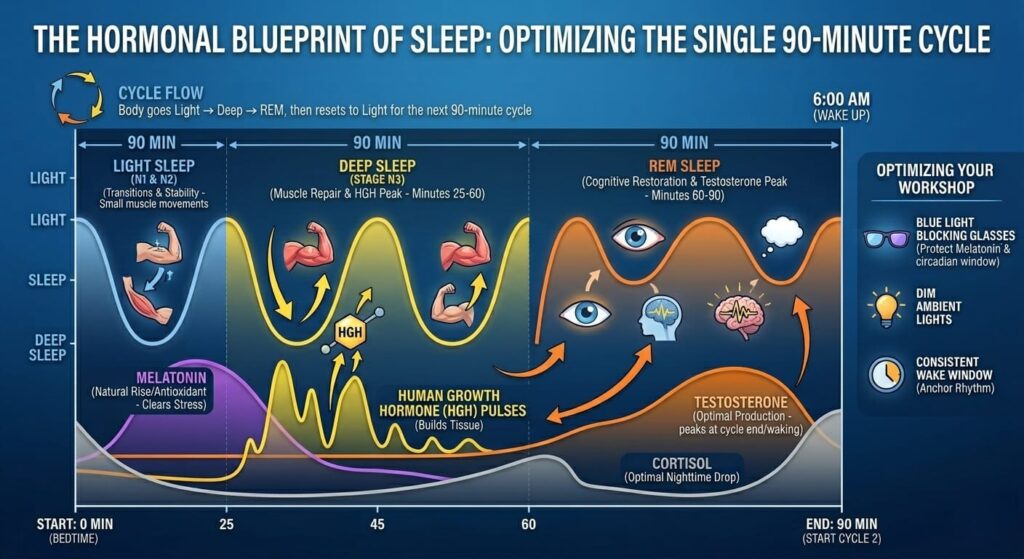
- Melatonin — the initiator, the timekeeper, the mitochondrial guardian.
- Cortisol — must drop to allow repair; when it doesn’t, destruction follows.
- Human Growth Hormone (HGH) — the primary tissue-rebuilding signal, released in its largest pulse of the day during sleep.
- Testosterone — reaches its daily peak during the overnight window.
Each of these hormones operates on a precise schedule. Disrupt the schedule, and you don’t just lose some recovery — you actively trigger a hormonal environment that works against you.
Let’s break down the two anchors of Part 1 in detail: melatonin and cortisol.
Melatonin: The Master Hormone of Darkness
Melatonin gets treated like a cheap supplement you take when you can’t sleep. That framing fundamentally undersells what this molecule does in an athlete’s body.
The Natural Pulse Mechanism
Melatonin is synthesized by the pineal gland and its secretion is governed almost entirely by light exposure. As ambient light — particularly blue-spectrum light — drops in the evening hours, your suprachiasmatic nucleus (the brain’s master clock) signals the pineal gland to begin melatonin production.
Under natural conditions, melatonin begins its pulse around 9:00 PM to 10:00 PM. This isn’t arbitrary. This timing initiates the entire biological sequence of sleep onset: core body temperature begins to drop, alertness signals quiet down, and the brain begins transitioning toward sleep-preparatory states.
This is the launch sequence for your nightly recovery operation. Delay or suppress it, and you push everything back — every hormone, every repair cycle, every adaptation.
Melatonin as a Mitochondrial Antioxidant
This is the part that most athletes never hear about, and it’s critical for understanding melatonin and sleep recovery at a performance level.
High-intensity training generates significant oxidative stress. Free radicals accumulate in muscle tissue and mitochondria. Inflammatory cytokines spike. This is a normal and necessary part of the adaptation signal — but it must be resolved. If oxidative damage accumulates without adequate clearance, mitochondrial function degrades over time, and with it, your aerobic capacity, power output, and recovery speed.
Melatonin is one of the most potent mitochondrial antioxidants identified in human physiology. It crosses the blood-brain barrier and penetrates directly into mitochondria, scavenging reactive oxygen species with exceptional efficiency. Endogenous melatonin — the kind your body produces naturally in darkness — is metabolized into a cascade of secondary antioxidant compounds that amplify this protective effect.
Translation for athletes: your melatonin pulse is not just a sleep signal. It is an active biological clearing process that cleans up the oxidative wreckage from your training and protects the very engines — your mitochondria — that power your performance.
Suppress that pulse with artificial light, and you’re training hard, accumulating damage, and then skipping the cleanup crew.
Cortisol: Your Best Ally by Day, Your Worst Enemy by Night
No hormone in an athlete’s profile gets more attention than cortisol. Most of the conversation focuses on chronic cortisol elevation and overtraining. But the timing of cortisol is just as important as the total output — and this is where nighttime physiology becomes critical.
Daytime Cortisol: A Performance Tool
Morning and daytime cortisol is exactly what you want. The cortisol awakening response (CAR) — the sharp spike in cortisol in the 30–45 minutes after waking — mobilizes energy substrates, sharpens mental focus, and primes the neuromuscular system. Cortisol drives glycogen mobilization, fatty acid release, and anti-inflammatory modulation that allows you to train hard without catastrophic tissue damage.
High daytime cortisol during intense training blocks is not a problem. It’s the physiological cost of competitive performance.
Nighttime Cortisol: The Destroyer
Evening cortisol is an entirely different story. For normal hormonal recovery to proceed, cortisol must fall significantly in the hours leading up to sleep. This drop is the prerequisite signal for HGH secretion, testosterone maintenance, and the full suite of anabolic processes that define deep sleep for muscle recovery.
When cortisol remains elevated at night — from psychological stress, poor sleep habits, late-night high-intensity training, excessive blue light exposure, or unmanaged life stress — the consequences are severe and specific:
- Muscle protein breakdown accelerates: Cortisol is catabolic by mechanism. At night, without the counterbalancing training stimulus, it selectively targets muscle tissue.
- HGH secretion is blunted: Growth hormone and cortisol operate in opposition. Elevated cortisol at the time of sleep onset suppresses the first-wave HGH pulse that drives the night’s primary anabolic cycle.
- Sleep architecture fractures: High nocturnal cortisol disrupts transitions between sleep stages, increases nocturnal awakenings, and dramatically reduces slow-wave deep sleep — the most physiologically critical sleep stage for athletic recovery.
- Insulin sensitivity degrades: Sustained cortisol exposure at night impairs glucose uptake in muscle tissue, worsening body composition over time regardless of diet.
The practical message: your ability to lower cortisol in the evening window is as important as your ability to raise it in the morning. Managing the evening transition is not about being soft. It is a precision hormonal strategy.
HGH and Testosterone: The Heavy Hitters (A Preview)
Human Growth Hormone and testosterone are the two most powerful anabolic signals in the athletic body. Both reach their daily peak during sleep. Both are exquisitely sensitive to sleep quality, duration, and architecture.
HGH secretion is almost entirely sleep-dependent in adults — the largest single pulse of the day occurs in the first deep sleep cycle, triggered by specific brainwave activity during slow-wave sleep. Miss deep sleep, and you miss the primary growth and repair window your training is designed to exploit.
Testosterone production follows a circadian pattern that peaks during sleep and reaches its highest point in the early morning hours. Even a single week of sleep restriction — as little as five hours per night — reduces testosterone levels by 10–15% in young men. In an athletic context, that’s the difference between adaptation and stagnation.
Part 2 of this series goes deep on both. The mechanisms, the windows, the specific sleep stages that trigger each, and the exact consequences of disrupting them. If you want to understand why deep sleep for muscle recovery is the most powerful anabolic tool available to natural athletes, that’s where we go next.
Sleep Architecture: The 90-Minute Engine of Recovery
Understanding how sleep is structured is the foundation for understanding why quality matters as much as quantity.
The 90-Minute Cycle
Sleep does not progress from light to deep in a single linear arc. It cycles. Approximately every 90 minutes, you complete a full sleep cycle that moves through distinct stages. A full night of quality sleep contains four to six of these cycles, each serving different biological priorities.
The stages within each cycle:
N1 – Light Sleep (Transition)
- The bridge between wakefulness and sleep.
- Lasts only a few minutes per cycle.
- Brain activity begins to slow; muscle tone reduces.
- Minimal recovery value — this is the doorway, not the destination.
N2 – Light Sleep (Stabilized)
- The largest proportion of total sleep time around 50%.
- Brainwave patterns appear that protect sleep from sensory disruption.
- Memory consolidation begins; motor learning is processed here.
- Metabolic rate drops; body temperature continues to fall.
N3 – Slow-Wave Deep Sleep (SWS)
- The physiological recovery cornerstone.
- Characterized by delta waves — large, slow oscillations of synchronized neural activity.
- The primary window for HGH secretion, tissue repair, and immune function.
- Dominated by the first half of the night; your first two to three cycles carry the largest deep sleep loads.
- This is where athletic recovery actually happens.
REM – Rapid Eye Movement Sleep
- The cognitive and neurological recovery phase.
- Dominates the second half of the night — cycles four through six are REM-heavy.
- Critical for motor pattern consolidation, emotional regulation, decision-making, and sport-specific skill refinement.
- HGH secretion is minimal during REM, but the neural work done here is irreplaceable.
Why the Full Architecture Matters
Each stage is not optional. Cutting total sleep time doesn’t just reduce sleep quantity — it surgically removes specific stages. Because deep sleep dominates early cycles and REM dominates later cycles, the stage you sacrifice most acutely depends on when you cut the night short.
Sleep from midnight to 5 AM? You’ve likely preserved some deep sleep but gutted most of your REM. Sleep from 2 AM to 7 AM? You’ve shifted toward REM but severely curtailed deep sleep.
For sleep architecture for athletes, the goal is to protect the complete cycle progression. This means respecting total duration, sleep onset timing, and the conditions that allow uninterrupted cycling through stages all night.
Disruptions — from noise, light, alcohol, late-night eating, stress, or temperature — don’t just fragment your sleep. They interrupt specific transitions between stages, preventing your body from entering or sustaining the deep sleep windows where the most critical hormonal recovery work takes place.
Light Management: Practical, Not Fanatical
The single most controllable input affecting your melatonin pulse, sleep onset, and sleep architecture quality is evening light exposure. But here’s where most sleep advice loses athletes: it becomes clinically impractical.
Real athletes have evening training sessions that run until 9 PM or later. They have film review, coursework, post-training meals, and normal social lives. Demanding a complete blackout from 7 PM onward is not a protocol — it’s a fantasy.
The actual dose-response relationship between evening light and melatonin suppression is what matters. High-intensity overhead lighting and direct screen exposure are the primary culprits — not ambient dim light or controlled screen use with mitigation strategies.
Practical, implementable steps for managing the evening light environment:
- Dim overhead lighting after 8:00–9:00 PM: Swap harsh white ceiling lights for warm-toned lamps or lower-intensity alternatives. This alone significantly reduces the light intensity hitting your retinal cells.
- Reduce direct screen time, but don’t eliminate it: You can review film, study, or decompress — just reduce the time spent staring directly into bright screens from close range in the two to three hours before your target sleep time.
- Enable warm/night mode on devices: This shifts screen color temperature and reduces blue-spectrum output during evening hours.
The Tactical Tool: Blue Light Blocking Glasses
For athletes operating in environments with limited light control — late-night training facilities, locker rooms with fluorescent lighting, evening classrooms — blue light blocking glasses represent one of the highest-return, lowest-effort interventions available.
Orange-tinted blue light blocking lenses filter the 450–480 nm wavelengths most responsible for melatonin suppression. Worn in the two to three hours before sleep, they allow you to function normally, maintain your full schedule, and review whatever you need to review — while simultaneously protecting your natural melatonin production as if the lights had already dimmed.
This isn’t a gimmick. A 2009 study published in Chronobiology International demonstrated that subjects wearing blue-blocking glasses in the evening experienced significantly better sleep quality and mood compared to controls under the same ambient light conditions. Subsequent research has consistently supported the mechanism.
The practical value for athletes: you don’t have to choose between professional preparation and recovery optimization. You wear the glasses, do your work, and let your endocrine system run its natural program.
FAQ: Sleep, Hormones, and Athletic Recovery
Why is sleep more important than nutrition and training for recovery? Sleep is the phase in which nutrition and training are actually converted into adaptation. Protein synthesis, hormone secretion, glycogen restoration, and neural consolidation all depend on sleep quality. Without it, nutrition and training produce diminishing or negative returns.
How does cortisol at night affect muscle recovery? Elevated nighttime cortisol is directly catabolic — it accelerates muscle protein breakdown in the absence of a training stimulus. It also suppresses HGH secretion and fragments sleep architecture, creating a compounding negative effect on recovery and body composition simultaneously.
What is melatonin’s role beyond helping you fall asleep? Endogenous melatonin functions as a potent mitochondrial antioxidant, clearing oxidative stress generated by training. It also initiates the hormonal recovery sequence that includes HGH and testosterone optimization later in the night. Suppressing it with artificial light disrupts far more than sleep onset.
How many sleep cycles does an athlete need per night? Five complete 90-minute cycles — totaling approximately 7.5 hours — is the evidence-supported target for athletes under high training loads. This preserves both adequate deep sleep (cycles one through three) and adequate REM (cycles four and five), protecting both physical and cognitive recovery.
Does blue light blocking actually improve sleep quality for athletes? The research supports it. Blue light blocking glasses worn two to three hours before sleep protect melatonin production in real-world artificial light environments. For athletes who cannot control their evening light exposure — late training, film study, coursework — they represent a practical and effective mitigation tool.
What is sleep architecture and why does it matter for performance? Sleep architecture refers to the structured cycling through light sleep, deep sleep, and REM sleep that occurs in approximately 90-minute intervals throughout the night. Each stage serves specific recovery functions — deep sleep drives tissue repair and HGH secretion, REM drives neural consolidation and skill refinement. Disrupting the architecture, even with the same total sleep hours, significantly impairs the recovery process.
The Foundation Is Set. Now Go Deeper.
You now have the framework. Sleep is not rest — it is an active, precisely orchestrated hormonal operation that makes or breaks everything you’re trying to build as an athlete. The melatonin pulse initiates it. Cortisol suppression enables it. Sleep architecture delivers it.
But we haven’t touched the most powerful anabolic window in the entire recovery process.
Part 2 of this series goes straight to Human Growth Hormone and testosterone — the two signals that determine whether your training actually builds what it’s supposed to build. You’ll learn exactly which sleep stage triggers the primary HGH pulse, how long that window lasts, what collapses it, and why an athlete with four hours of sleep and eight hours of deep sleep would theoretically outperform an athlete with eight hours of fragmented sleep.
That’s not a typo. The quality of your sleep architecture — specifically your slow-wave deep sleep — determines the magnitude of your body’s most powerful anabolic signal, independent of total sleep time.
Part 2: “The HGH Window: Why Deep Sleep Is Your Most Powerful Anabolic Tool” — coming next.
This article is Part 1 of a three-part series on hormonal recovery and sleep optimization for athletes.
Pingback: - The HGH Window: How Deep Sleep Drives Muscle Growth
Pingback: Sleep Optimization Protocol for Athletes