

This isn’t a supplement story — this is a critical hormone story.
As a high-performing athlete, the stakes are higher than you might realize: every system that dictates your recovery and your explosive power relies on a Vitamin D switch.
But here’s the problem — you’re probably flipping this switch completely wrong.
Blindly supplementing with standalone D3 without understanding how it actually absorbs is a dangerous metabolic trap. It leaves calcium wandering aimlessly in your bloodstream, potentially depositing in your kidneys and arteries — instead of strengthening your bones and driving your muscle recovery,
The Standalone D3 Trap: Why Your Supplement May Be Harming You
Most athletes assume that taking Vitamin D3 is enough. It isn’t. And the consequences of getting this wrong go far beyond a simple deficiency
The Missing Activation Switch
When you supplement with D3 alone, your body increases calcium absorption dramatically. But without Vitamin K2, that calcium has no destination. K2 is the biological director of two critical proteins:
- Osteocalcin: The protein that physically locks calcium into your bone matrix.
- MGP (Matrix Gla Protein): The arterial guardian that prevents calcium from embedding into your vessel walls.
Without K2, both proteins remain completely inactive. Your calcium doesn’t build bones. It drifts.
Why D3 Is Not Like Your Other Supplements
This is where Vitamin D becomes genuinely dangerous if mishandled. Unlike water-soluble vitamins such as Vitamin C or the B-complex – where your body simply flushes any excess through urine—Vitamin D is fat-soluble.
Your body cannot eliminate the surplus through urine. Instead, it gets stored in your liver and fatty tissues, accumulating silently over time. When those stored levels build up, they trigger an uncontrolled, aggressive surge in calcium absorption—flooding your bloodstream with calcium your body has no mechanism to direct. Without Vitamin K2 present, this isn’t just inefficiency; this is a toxic time bomb for your kidneys and arteries.
What Free-Floating Calcium Does to an Athlete
This isn’t a theoretical risk. It’s a measurable athletic performance destroyer.
Unguided calcium deposits into the micro-filters of your kidneys, forming stones that silently compromise your hydration and detoxification capacity. Worse, it hardens your arterial walls, reducing cardiovascular elasticity – crushing the very endurance and power output you train for. You’re not just wasting your supplement; you’re potentially calcifying your performance infrastructure.
The Real Source of Performance-Grade K2
Here’s what most health blogs won’t tell you: Plant foods only contain Vitamin K1 – which handles blood clotting. It does NOT activate Osteocalcin or MGP.
True performance-grade Vitamin K2 (specifically MK-4 and MK-7) comes exclusively from nutrient-dense animal fats:
- Pasture-raised egg yolks
- Chicken liver & Beef liver
- Grass-fed butter
These are not optional additions to your nutrition plan. For any athlete supplementing with D3, they are non-negotiable.
D2 vs. D3: The Commercial Deception and The Forgotten Forms
Not all Vitamin D is created equal. In fact, the supplement industry has been exploiting this confusion for decades – and your athletic performance is paying the price.
The Commercial Deception: What’s Actually Inside Your Multivitamin
Turn over your multivitamin bottle and read the label carefully. If it simply says “Vitamin D” – without specifying the form—you are almost certainly getting Vitamin D2 (Ergocalciferol).
D2 is cheap. It is plant-derived. And it is biologically inferior. Your liver struggles to convert it into the active hormonal form your cells actually use. It clears from your bloodstream rapidly, leaving no meaningful hormonal impact. Clinical data consistently shows that Vitamin D3 is up to 3 times more effective than D2 at raising actual Vitamin D hormone status in the blood.
Vitamin D3 (Cholecalciferol) is the bioidentical form—structurally identical to what your skin produces when exposed to UVB sunlight. It is animal-sourced, metabolically stable, and the only form with proven, performance-grade impact. If your supplement label doesn’t explicitly say D3, you are paying for a placebo.
The Historical Ghost: Vitamin D1
Vitamin D1 does not exist in modern medicine – and for good reason. It was never a real compound.
Early 20th-century researchers believed they had isolated a distinct form, but later analysis revealed it was simply a contaminated mixture of D2 and lumisterol – a byproduct of UV irradiation with no biological function. D1 was a scientific error.
It was quietly removed from medical literature and has zero relevance to human physiology or athletic performance.
The Lab Ghosts: Vitamin D4 and Vitamin D5
Vitamin D4 and Vitamin D5 do technically exist — but exclusively in fungal biochemistry and synthetic laboratory environments.
Human biology completely lacks the enzymatic pathways to activate or utilize either form. For an athlete focused on performance, recovery, and hormonal optimization — D4 and D5 are entirely irrelevant. They will not raise your hormone levels, they will not bind to your VDR receptors, and they will not influence a single gene in your muscle tissue.
The only form worth your attention remains Vitamin D3 (Cholecalciferol) — produced by your skin, mirrored by your supplements, and the absolute foundation of your biology.
The Metabolic Assembly Line: From Bare Skin to Steroid Hormone
When you step out into the sun or swallow a D3 capsule, your body does not instantly receive an active hormone. Instead, it receives raw material. To turn this raw material into an athletic recovery weapon, your body must push it through a highly complex, multi – organ metabolic assembly line. If a single organ in this chain is sluggish or compromised, your Vitamin D tracking completely fails.
The Skin and The Cholesterol Spark
The journey begins on the cellular surface of your skin cells. Your body utilizes a specific type of cholesterol (7-dehydrocholesterol) as the baseline matrix. When raw UVB sunlight hits your bare skin, it shatters this cholesterol structure, synthesizing an initial, completely inactive precursor called pre-vitamin D3.
This compound has zero biological power at this stage. It cannot build muscle, it cannot regulate immunity, and it cannot talk to your genes. It is simply a passenger entering the bloodstream, waiting for the first major factory stop: The Liver.
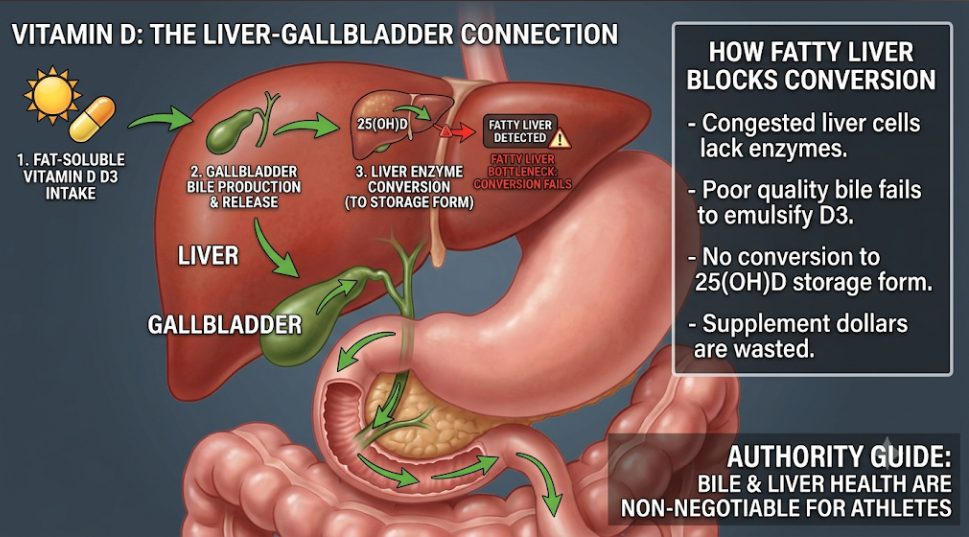
The Liver Milestone: The Sluggish Organ & Gallbladder Trap
Once in the bloodstream, the inactive precursor travels straight to your liver. Here, liver enzymes convert it into 25-hydroxyvitamin D [25(OH)D]—which is the official storage form of Vitamin D that doctors measure when you get a blood test.
But here is the ultimate authority angle that most fitness blogs completely ignore: A sluggish liver or poor gallbladder health acts as a brutal bottleneck for athletes.
Because Vitamin D is strictly fat-soluble, its absorption in the gut relies entirely on high-quality bile produced by your liver and concentrated by your gallbladder to emulsify dietary fats. Furthermore, if you are an athlete dealing with a sluggish, congested, or mildly fatty liver (often driven by high sugar, processed foods, or poor metabolic health), your liver enzymes will be completely bogged down.
The result? Your body fails to execute this first major conversion. You can take the highest quality D3 drops or spend hours in the sun, but it will never convert into the storage form. It simply gets wasted.
The Kidney Finish Line: Activating Your Power Output
For the lucky athletes with clean livers, the storage form leaves the liver and heads to the final destination: The Kidneys.
Inside the kidneys, a highly regulated enzyme (1-alpha-hydroxylase) performs the ultimate bio-transformation. It converts the storage form into 1,25-dihydroxyvitamin D, scientifically known as Calcitriol.
Calcitriol is not a vitamin; it is the true active steroid hormone. This is the final form that unlocks your cellular infrastructure, floods your system with energy, binds directly to Vitamin D Receptors (VDR) in your muscle tissues, and drives explosive gym performance and rapid neuromuscular recovery.
The Sun Exposure Myth and The Golden Performance Menu
You’ve been told that getting some sun is enough. It isn’t—and for a serious athlete, this misunderstanding is costing you real hormonal output.
Why Your Face and Hands Are Not Enough
Most people step outside, expose their face and hands, and assume their Vitamin D needs are covered. They are wrong. Your skin synthesizes Vitamin D3 based on one critical factor: surface area.
Your face and hands represent a fraction of your total skin surface. Worse, they are chronically sun-adapted—meaning the skin in these areas has already downregulated its sensitivity to UVB stimulation.
The true high-yield synthesis zones are your back, abdomen, and thighs. These large body regions are less sun-adapted, and they contain a significantly higher density of 7-dehydrocholesterol—the cholesterol precursor that UVB rays convert directly into pre-Vitamin D3 in your skin cells. For maximum hormonal output, these zones must be exposed. There is no shortcut.
The Timing Trap: UVA vs. UVB
Not all sunlight is equal-and most athletes are training at the wrong time for Vitamin D synthesis. Early morning and late evening sunlight is dominated by UVA rays. UVA penetrates deeply but cannot synthesize Vitamin D3. It ages your skin; it does not fuel your hormonal system.
UVB rays — the only wavelength capable of triggering Vitamin D3 synthesis — are only present at meaningful levels when the sun is high in the sky.
The optimal window for a high-performing athlete is midday exposure—approximately 15 to 20 minutes of direct sunlight on large body zones, without sunscreen. Sunscreen, even at SPF 15, blocks UVB radiation almost entirely. Apply it after your synthesis window — not before.
The Golden Performance Menu
Sun exposure is not always available. Weather, geography, training schedules, and seasonal shifts all create gaps in your Vitamin D synthesis. This is where your nutrition must compensate — but not with plants.
Plant-based foods contain zero Vitamin D3. They may offer trace amounts of the inferior D2 (Ergocalciferol)—which, as we established, your body cannot efficiently convert into active hormone. The only foods that deliver true performance-grade D3 come from animal sources.
This is your Golden Performance Menu:
- Wild-caught salmon: One of the highest natural sources of bioavailable D3 per serving.
- Atlantic mackerel: Dense in D3 and rich in the omega-3 fatty acids that enhance its absorption.
- Cod liver oil: The ancestral performance supplement, delivering concentrated D3 alongside Vitamin A for immune and hormonal synergy.
- Pasture-raised egg yolks: The most accessible daily source, with D3 concentrated in the fat-rich yolk, not the white.
These are not health trends. These are the evolutionary foods your hormonal system was designed to run on.
The Bottom Line: Don’t Just Take Vitamin D—Take It Right
Vitamin D3 is one of the most powerful hormonal tools an athlete can use. But its full potential is only unlocked when taken as part of a complete biological system.
The non-negotiable stack for every serious athlete:
- Vitamin D3: Your hormonal foundation.
- Vitamin K2 (MK-7): Your calcium traffic director.
- Magnesium: Your metabolic activation key.
- Healthy Dietary Fats: Your gut absorption vehicle.
This is not optional. This is the absolute difference between a supplement that transforms your physical performance—and one that silently calcifies your arteries.
Build the stack. Activate the hormone. Own your recovery.
Ready To Go Deeper?
In our next guide, we break down the exact D3 + K2 + Magnesium dosage protocols—the precise forms, the synergy mechanisms, and why this combination is the non-negotiable foundation of elite athletic recovery and testosterone optimization.
→ Continue Reading: [The Complete Absorption Protocol — Article 2 Coming Soon]