

There is a debate that has existed in running communities for decades — and it is surprisingly personal. Ask ten runners when they prefer to run and you will get ten different answers, each delivered with quiet conviction, as if the timing of their training is somehow a reflection of their character.
Morning runners swear by the clarity that comes from starting the day in motion. Night runners will tell you that their evening runs are the only thing standing between them and a complete mental breakdown after a long workday. Both are right — for themselves.
But beyond personal preference, the question of morning vs night running has a real answer when framed correctly. Not which is universally better, but which is better for you — for your goals, your physiology, your schedule, and your long-term consistency.
This article lays out everything: the science, the practical reality, the performance differences, and the honest truth about which choice will serve most runners best.
What the Science Actually Says About Running Timing
Before diving into practical advice, it helps to understand what is actually happening in your body at different times of day — because your body is not the same machine at 6 AM as it is at 7 PM.
Body Temperature and Performance
Your core body temperature follows a predictable daily rhythm. It is at its lowest point in the early morning hours — around 4 to 5 AM — and reaches its peak in the late afternoon, typically between 4 and 7 PM.
This matters for running because muscle function, reaction time, cardiovascular efficiency, and even lung capacity are all closely linked to core body temperature. When your body temperature is higher, your muscles are more pliable, your joints are better lubricated, and your overall athletic output tends to be higher.
Multiple studies have confirmed this: on average, runners perform measurably better in the late afternoon and early evening than they do first thing in the morning. VO2 max — a key measure of aerobic fitness — tends to be higher later in the day. So does muscle strength and power output.
Does this mean morning running is inferior? Not at all. It means morning running comes with a small but real physiological disadvantage — one that diminishes significantly with a proper warm-up, and one that most recreational runners will never notice in their day-to-day training.

A proper dynamic warm-up is essential to elevate body temperature and prepare cold muscles for a morning run.Hormones: Cortisol, Testosterone, and Melatonin
Your hormonal environment changes dramatically across the day, and understanding this gives you a real edge in timing your runs strategically.
Cortisol is at its highest in the morning — a natural response your body uses to wake you up and prepare you for the demands of the day. High cortisol is a double-edged sword for runners. On one hand, it mobilizes energy stores and enhances alertness. On the other, chronically elevated cortisol from stacking a hard training session on top of an already-stressed system can blunt recovery and increase muscle breakdown. This is why genuinely hard workouts — intervals, tempo runs — are physiologically better tolerated later in the day for most people.
Testosterone, which plays a role in muscle repair and adaptation, tends to peak in the morning for men and follows a similar but less pronounced pattern in women. Morning training may therefore be marginally better for stimulating muscle adaptation — though the difference for recreational runners is not significant enough to make a meaningful decision around.
Melatonin — the hormone that signals your body to prepare for sleep — begins rising in the evening. Running too close to bedtime can delay or suppress melatonin release, disrupting sleep quality. This is one of the most legitimate concerns about night running, and one worth taking seriously.
Morning Running — The Honest Picture
What Morning Running Does for You
- It builds consistency: This is the single biggest advantage of morning running, and it is not a small one. The morning is the only part of the day that reliably belongs to you. No unexpected meetings, no social obligations, no fatigue from a difficult afternoon. Runners who train in the morning show up to their sessions more consistently over time — and consistency is the variable that determines long-term progress more than any other.
- It sets your mental tone for the day: There is something real about completing a physical challenge before most people have had their first coffee. It creates momentum. Decisions feel easier. Focus is sharper. The scientific term for this is “exercise-induced dopamine and serotonin release” — but the practical experience is simply that morning runners tend to report feeling better for the rest of the day.
- It works better for fat burning in a fasted state: Running in the morning before breakfast — in a fasted state — shifts your body toward burning a higher proportion of fat as fuel. Glycogen stores are partially depleted after a night of fasting, so your body relies more heavily on fat oxidation to power the run. For runners whose goal includes body composition improvement, fasted morning runs at a comfortable Zone 2 pace can be a genuinely effective strategy.
The Real Challenges of Morning Running
- Cold, stiff muscles: After hours of sleep, your muscles are literally cooler and less pliable than they will be later in the day. This makes injury risk slightly higher in the first ten to fifteen minutes of a morning run. The solution is simple: extend your warm-up. Five minutes of brisk walking followed by dynamic movements before you begin running is not optional in the morning — it is essential.
- Lower peak performance: If you are racing, doing intervals, or testing a personal best, the morning is not the optimal window for most people. Your cardiovascular system needs time to fully wake up, and your reaction time and neuromuscular coordination are not yet at their daily peak.
- Nutritional timing is trickier: Running on a completely empty stomach works well for easy Zone 2 efforts lasting under 60 minutes. For anything longer or harder, you may need a small, easily digestible snack 30 to 45 minutes before heading out — something like a banana or a few dates.
💊 For morning runners doing longer efforts: Electrolyte balance matters more than most beginners realize. After a night of fasting, sodium, potassium, and magnesium levels can be lower than optimal. A quality electrolyte supplement taken before or during your run can make a noticeable difference in how you feel, especially in warm weather. → Check the electrolyte supplement we recommend
on iHerb — rated 4.5 by over 6,400 athletes:HydrationUP Electrolyte Mix — View on iHerb
Use code PTF2597 for a discount on your first order
Night Running — The Honest Picture
What Night Running Does for You
- Peak physical performance: As discussed, your body is genuinely performing closer to its athletic ceiling in the late afternoon and early evening. If you are training for a race, chasing a personal best, or doing quality sessions like tempo runs and intervals, the evening gives you the physiological conditions to perform at your best.
- Stress relief and mental decompression: For many people, an evening run is the most effective tool they have for processing the stress of the day. There is something deeply effective about using physical movement to discharge the accumulated tension of work, obligations, and the constant stimulation of modern life. Night runners often describe their evening sessions as non-negotiable — not because they are disciplined, but because the alternative is simply worse.
- Warmer, more flexible muscles: By evening, your muscles have been in use for hours. They are warmer, more supple, and more ready to perform than they were at 6 AM. This means less warm-up time needed and a lower injury risk during the main body of the session.
The Real Challenges of Night Running
- Sleep disruption — the big one: This is the issue that night running critics point to most often, and it is legitimate. Vigorous exercise raises your core body temperature, elevates adrenaline and cortisol, and delays the release of melatonin. If you run hard at 9 or 10 PM and then try to fall asleep an hour later, you may find that your body is still in performance mode when your pillow expects it to be in sleep mode.
- Safety and visibility: Running at night requires reflective gear and a well-chosen route. This is not a reason to avoid it — but it is a real consideration, especially in areas with limited street lighting or unpredictable traffic. A simple clip-on running light and reflective vest solve this problem entirely.
- Consistency can be harder to maintain: The evening is the part of the day most vulnerable to disruption. A dinner invitation, a work deadline, an unexpectedly exhausting afternoon — these things can derail an evening run in a way they simply cannot derail a morning session that is already done by 7 AM.
💊 For night runners who struggle with post-run sleep: Magnesium is one of the most well-researched and underused tools for sleep quality in athletes. It supports muscle relaxation and melatonin production — making it particularly relevant for runners who train in the evening. → Check the exact supplement we recommend
on iHerb — rated 4.8 by over 25,000 athletes:Magnesium Bisglycinate — View on iHerb
Use code PTF2597 for a discount on your first order
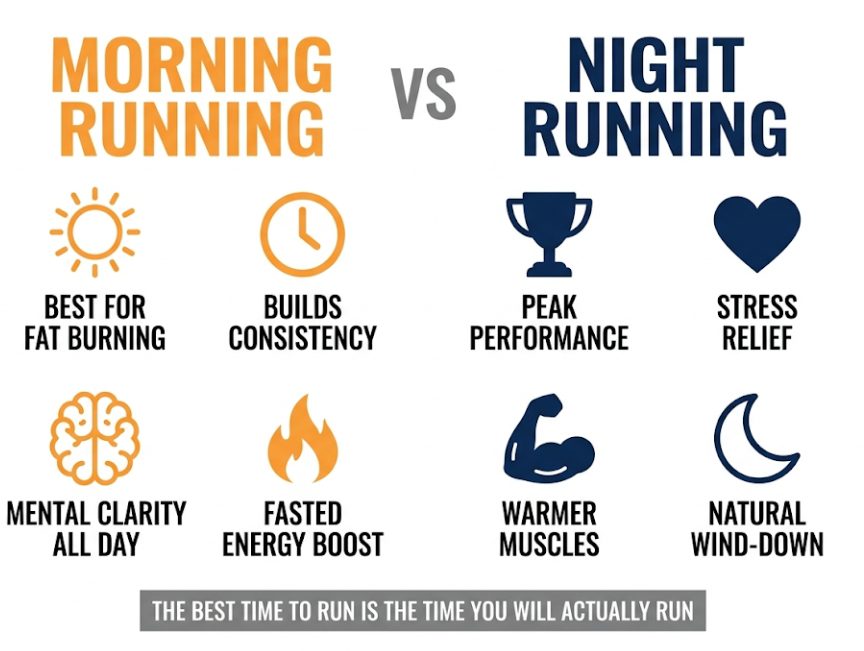
Direct Comparison — Side by Side
| Factor | Morning Running | Night Running |
|---|---|---|
| Physical performance | Slightly lower | At its peak |
| Fat burning | Higher (fasted) | Normal |
| Consistency | Easier to maintain | More vulnerable to disruption |
| Stress relief | Prevents stress buildup | Releases accumulated stress |
| Sleep impact | Neutral to positive | Risk of disruption if too late |
| Injury risk | Slightly higher (cold muscles) | Lower (warm muscles) |
| Mental clarity afterward | All day | Evening only |
| Willpower required | More (early wake-up) | Less |
Which Should You Choose?
Here is the honest answer: the best time to run is the time you will actually run.
No amount of physiological advantage in the evening matters if you consistently skip evening runs because life gets in the way. And no slight performance deficit in the morning matters if the only sessions you reliably complete are the ones done before the rest of the world is awake.
That said, if you are genuinely indifferent — if both times are equally available to you — here is a practical framework:
Choose morning running if:
- Your schedule is unpredictable in the evenings
- You are focused on building a long-term running habit
- Your primary goal is fat loss or body composition
- You are a beginner building consistency from scratch
Choose night running if:
- You are training for performance and chasing personal bests
- Your mornings are genuinely unavailable or chaotic
- You need running for evening stress management
- You naturally feel stronger and more alert in the evenings
- You can finish your run at least 2 to 3 hours before sleep
And if you are somewhere in between: many experienced runners do exactly what works — easy Zone 2 runs in the morning and quality sessions in the evening, when performance capacity is highest. This hybrid approach is common among runners training four or more days per week.
Practical Tips for Each Timing
For Morning Runners
- Set your kit out the night before — remove every possible barrier between you and the door.
- Walk briskly for five minutes and do dynamic stretches before your first running step.
- For runs over 45 minutes, consider a small snack 30 minutes before — a banana or a few dates.
- Hydrate immediately upon waking — you are mildly dehydrated after a night of sleep.
For Night Runners
- Define a hard cut-off time — no running after 8:30 PM if you sleep at 11, for example.
- Keep evening sessions easier if you notice they are affecting your sleep.
- Use a wind-down routine after your run: a cool shower, light stretching, low light.
- Wear reflective gear without exception — visibility saves lives.
Frequently Asked Questions
Does running in the morning burn more fat than running at night?
Fasted morning running does increase the proportion of fat used as fuel during the session. However, total daily fat loss depends on overall energy balance — calories consumed versus calories burned — more than the timing of exercise. Fasted morning runs are a useful strategy, not a magic solution.
Will running at night ruin my sleep?
Not necessarily. The key variable is the gap between your run and your bedtime. Finishing a run two to three hours before sleep is sufficient for most people. High-intensity sessions close to bedtime are more disruptive than easy runs. Pay attention to your own response — everyone’s sensitivity is different.
Is it safe to run alone at night?
With the right precautions, yes. Choose well-lit, familiar routes. Wear reflective clothing and a running light. Share your route with someone. Run against traffic so you can see oncoming vehicles. These habits make night running safe and routine.
Can I switch between morning and evening running?
Absolutely. Many runners vary their schedule week to week based on commitments and energy levels. Your body adapts remarkably well to variable training times. The only situation where consistency in timing matters more is immediately before a race — in which case, training at the same time as your race start is worth doing in your final two to three weeks of preparation.
What should I eat before an early morning run?
For easy runs under 45 minutes, many runners run fasted without any issues. For longer or harder sessions, a small, easily digestible option — a banana, a few dates, or a slice of toast with honey — taken 30 to 45 minutes before the run is sufficient. Avoid high-fat or high-fiber foods immediately before running.
Conclusion
Morning or night — this is not a question with a single right answer. It is a question about who you are, what your life looks like, and what you are training for.
What matters far more than the hour on the clock is what you do consistently over weeks and months. The runner who trains three mornings a week, every week, for six months will outperform the runner who plans perfect evening sessions and completes half of them.
Choose the time that fits your life. Protect it. Show up to it repeatedly. And let the results speak for themselves.
📘 Want a complete, structured running plan that covers training, nutrition, and recovery in one place?
We are currently building the OptiRestFuel Complete Runner’s Guide — a comprehensive PDF designed for runners at every level, from first kilometer to marathon finish line.
→ [Join the waitlist and be the first to get it when it launches. (Waitlist Link — Coming Soon)]
This article is part of the OptiRestFuel complete running series.
⬅ Previous Article: Running Distances Explained: From 1K to Marathon
➡ Next Article: Running Recovery & Injury Prevention: How to Train More and Break Down Less
Pingback: Running Distances Explained: From 1K to Marathon